
Overview:
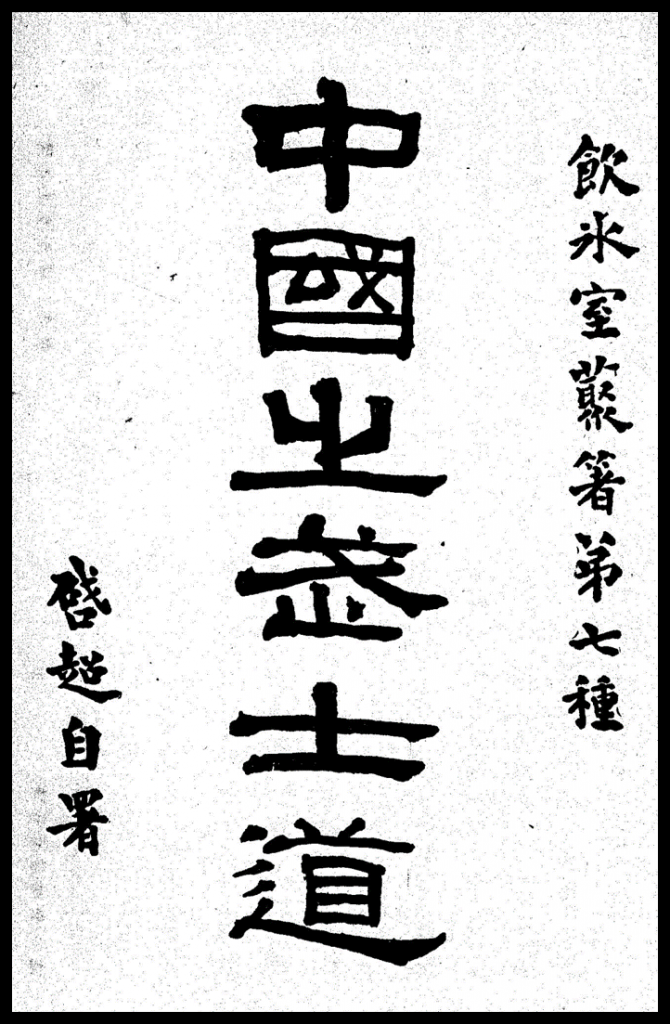
Liang Qichao’s “China’s Bushido” (1904)
This research project examines the long history of China-Japan relations from the perspective of perceived martial virtues in both countries. In both societies, concepts of “martial” and “civil” have played important roles in identity formation, and this dynamic was enhanced with the advent of the modern nation-state. For China, long the intellectual and cultural center of East Asia, the advent of modernity brought several catastrophic military defeats that seemingly discredited its martial traditions. In contrast, Japan had long been identified with martial prowess and virtues under the warrior rule of the shoguns, and reinterpreted and resurrected these ideals as part of the construction of its empire. The widespread view that Japan is a martial country while China practices civil virtues remains influential in the twenty-first century, and is typically portrayed as being rooted in ancient traditions. This project draws on Chinese and Japanese sources to examine the historical development and impact of these perceptions on relations between the two countries.
Select publications:
“The Samurai Next Door: Chinese Examinations of the Japanese Martial Spirit,” Extrême-Orient Extrême-Occident, No. 38 (Jan. 2015). pp. 129-168.
“National Consciousness and the Evolution of the Civil/Martial Binary in East Asia,” Taiwan Journal of East Asian Studies, Vol. 8:1, Issue 15, (June 2011). pp. 129-171. PDF
“Wang Yangming and Bushidō: Japanese Nativization and its Influences in Modern China,” Journal of Chinese Philosophy Vol. 36, No. 3 (Fall 2009). pp. 439-454.
Blog posts:
“Liquid Bread, Global Circuses, and China’s German Heritage,” Making History, April 19, 2016.
“Gentlemen, Samurai, and Germans in China,” OUP Blog, Nov. 1, 2014.